Showing posts with label Mozambique. Show all posts

Wednesday, November 16, 2011

On the Chapa


At some point during the journey, I told myself that if I made it in one piece, I’d never do this again.

Ride on the back of a flat-bed truck, that is, crammed in with a couple dozen other people on top of grain sacks, crates of bottles, cloth-wrapped bundles and miscellaneous suitcases, some of which had clothing bursting out where the zipper should be.

On the way up to Cobué in August, I’d been lucky enough to get a seat in the cab of one of the chapas that carry people and cargo around on the dirt roads of northern Mozambique. But heading south again a month later, I was a few minutes too late for that. When the boat from Nkwichi dropped me at Julius’s backpacker lodge in Cobué, the chapa was already there and the cab was already full. There was nothing for it but to grab the edge of the truckbed, put my foot up on one of the big tires, and clamber into the back.

Really, I was lucky, I told myself. These trucks run just once or twice a day, and I needed to leave that day to catch a plane in Lichinga, the nearest city. I’d sent a message asking the chapa driver to wait for me, and he had. And as the first person in the back, I could claim a spot with my back to the cab. I put my backpack down on the wooden bed of the truck and sat down on it, tucking my shoulder bag in next to me. With my basket under my knees and my inflatable travel pillow behind me, I was as comfortable as a person can be in the back of a truck.

The driver and the conductor finished tying down a cluster of yellow plastic gas cans, then the driver got behind the wheel and the conductor held onto the side of the cab. The truck turned around and headed up the steep hill toward the church, which was still battered and roofless from Mozambique’s civil war. 


The truck stopped and the small crowd waiting there piled on with their bundles and bags. A man in a t-shirt and jeans carried a rifle and a clip of bullets. Women had their heads wrapped in colorful printed cloths and many had babies tied onto their backs with more cloth; most had long skirts made of the same. Nonetheless, they climbed up nimbly and settled themselves in on the mounting pile of cargo. Some people carried bread rolls or ears of corn, and others bought food from the vendors who came to the side of the chapa.

Maybe 20 people got on. I thought, this isn’t so bad, but of course we were just getting started. We stopped maybe four or five more times before we even left Cobué, more people piling on each time, somehow fitting into the growing pile of humanity and goods. The conductor—the local Portuguese word means “pincer” for the manner in which he takes your money—was gentle at first, passing babies and children and sacks around, pointing out to people where they would fit best. But he got harsher as the loading went on and yelled impatiently at an older woman who didn’t move quickly enough. An impossible number of people ended up on board, more than I could count, all meshed in like a human form of Tetris.

People were astonishingly patient, cooperating easily to make room, adjusting their positions to fit each other in, taking bundles for people, holding babies while their mothers got settled. Everybody just accommodated each other with no sighing or complaining or jostling for a better spot. We were literally squeezed together, limb pressing against limb, people using each other as armrests. For the first part of the ride, I had the bottom of somebody’s wheeled luggage wedged against my anklebone, a woman’s feet on top of mine, a man’s knees pressing against my side, and the woman’s hand on my thigh. Well, I told myself, the more tightly we’re wedged on, the less likely anybody is to fall off.  

The road was rough, a narrow, sandy, hilly track through the woods. At times we jounced very near the deep ditches and washouts, the heavily laden truck leaning over precariously. But I had no other way to get to Lichinga, and I got myself into a fatalistic mood. Chances are we’ll make it, I kept telling myself.

Everyone around me was talking but they spoke Chinyanja and I couldn’t follow or join in. People looked at me curiously when they got on, but after that nobody paid me much attention.

It was hard not being able to shift position, and after a while my knees and hipbones began to ache. But just when I thought I couldn’t bear it any more, we stopped and the woman whose feet were on mine climbed out of the truck at a mud house. Somebody else got on and we were jammed in again like before, but just being able to move for a moment let the blood flow through my legs again.

Everyone else seemed totally nonchalant, able to sit quietly in one position. But maybe they were hurting too and just not showing it.

On and on we jounced. I knew the trip should take about four hours, but I’d learned that in Mozambique it’s better not to pay too close attention to the time. At some point, we stopped for a group of people with three big sacks bulging with manioc root or corn.

“Sister, stand up!” the conductor called to me in English.

I wasn’t sure I could. My feet were wedged in again and I wasn’t sure my legs were going to move. But somehow I did stand, and I held onto the top of the cab, my feet on the metal edge of the flatbed wall, while they loaded up the sacks.

The conductor patted my backpack. “No problem?” he asked.

“No problem,” I said. “It’s OK.” So he put one of the sacks on top of my backpack and then I had to sit on top of the sack, much higher than I was comfortable with. But I discovered that if I leaned inward a bit and kept one hand on the metal wall, I was secure enough. I kept having to shift the pillow behind me—otherwise, the metal bars between the cab and the flatbed would pound into my back on every jounce—but I managed to stay on.


Meanwhile, I was saying goodbye to Manda Wilderness, where I’d so happily spent the last five weeks. When we climbed the hills out of Cobué, I got my last glimpses of the wide blue lake. When we passed the junction where we’d come in on Julius’s truck after the village trip a week earlier, I felt a pang of sadness. At the village of Mandambuzi, I saw again the school the trust built and is now expanding.  And a little further south, we passed the spot where my chapa had broken down on the way to Cobué. I thought about how strange and new everything was then, and how familiar it had become, how attached I’ve gotten to this landscape.

Then my nostalgia and anxiety were relieved in a most unexpected way. Somewhere south of Mandambuzi a mother with a nursing baby tied to her chest climbed on. She had two young boys with her and she tucked them in next to her. But her husband had to cling onto the back of the truck. Hurried by the conductor, he glanced hesitantly at me—a complete stranger and the lone white person on the truck—and apologetically handed me his little daughter. There was nowhere else for her to ride.

I smiled at him to show him it was all right and settled the little girl, maybe a year and a half old, onto my lap. I wrapped my left arm around her with my hand flat against her round belly to keep her on. Her right leg was bumping against the metal rail and I put my hand down to cushion it. Her mom smiled and gave me a thumb’s up, but one of the little boys kept a close eye on me for miles, apparently wondering whether his sister was in good hands.

I suppose I was doing the family a favor, but it felt more like one was being done for me. The girl’s solid little weight was oddly comforting, and she was utterly calm. Carrying her and making sure she was secure took my mind off my own safety and made me feel more a part of things, a little less the muzungu lady inexplicably riding the truck. The girl coughed now and then, and when I patted her belly, a thin older lady riding near me smiled.

The girl picked at the half-ear of corn she was carrying and seemed totally unfazed, and the acceptance of a toddler was surprisingly affirming. People along the road and at the places we stopped seemed surprised to see a white woman with a Mozambican baby on her lap, but the little girl’s mom seemed to enjoy it. She even called out to some people we passed as if she wanted to make sure they saw.

On and on we went, on and on. The sun was hot now that we were more in the open, and the truck tires slid on the loose sand as we headed down the hills. I could tell the little girl wasn't wearing diapers. I hoped she wouldn't pee on me, and she didn't. In one town we passed through, fabric capulanas flew from long bamboo poles and women and children were gathered in front of a house, one banging a yellow plastic gas can with a stick, others blowing whistles or shaking rattles made from soda cans filled with stones or beans. Maybe it was a holiday or something to do with the All-Africa Games then underway in Maputo.

I didn’t know. By then I was hot, ravenous, lightheaded and gritty with dust from the road. I think it was at this point that I promised myself that if I got safely to Lichinga, I’d never ride in a chapa again. But holding onto the little girl grounded me, and soon enough, there we were at the intersection that serves as Metangula’s depot and transfer station.  

I gave the girl back to her dad, climbed down and went off and got lunch—fish, nsima and an orange Fanta in a little market restaurant buzzing with flies. Then I came back to the junction to wait for the mini-bus headed for Lichinga. I didn’t know it yet, but on the next leg of the journey I would get to sit up front on the bench seat next to the driver. And though the shoulder bag holding my laptop would go flying out the back of the mini-bus onto the paved highway, the computer inside would miraculously escape undamaged.

I’m convinced that those strokes of luck were due to the good wishes of the little girl’s family. I came upon them again at the chapa corner, sitting in the shade under an overhanging grass roof, waiting for their ride to Bandeze.  

We smiled at each other. I introduced myself as best I could in Portuguese and asked their names.

Then I asked in a kidding way, “Where’s my little girl?” I could see perfectly well she was on her dad’s lap, but the little boy who’d regarded me so warily on the chapa went and got her. He solemnly brought her over to me, and she climbed onto my lap, utterly unconcerned who held her.

Soon their chapa came along and we all said goodbye. After he loaded his family up, the dad came back and held out his hand to me, his left hand touching his right elbow in the extra-polite Mozambican gesture of respect. He was speaking seriously in Portuguese and all I really understood was “Obrigado.” I understood he was thanking me for carrying his daughter, but I didn’t know how to say “I enjoyed it, no problem,” much less express how reassuring the little girl's presence had been.

So I just said “Obrigada” back. Then we wished each other a good voyage and went our separate ways.  

(KK)

Tuesday, November 15, 2011

Into the Wilderness

A three-day journey in Africa's Siberia.

(KK)

Uchesse, Mozambique, August 31 – The sun is going down, a pink ball above the hilly purple silhouette that is Malawi’s Likoma Island. The Miss Nkwichi, the broad, slow-moving wooden boat that brought us here, is moored just off the Mozambique side of Lago Niassa, a.k.a. Lake Malawi. Our five tents are set up on the wide, pale sand beach. Behind them, leafless baobabs stand like giant gray root vegetables stuck upside down in a jumble of underbrush.

Maaike, Devon and Joseph have just come back from meeting with the elders of the small village just beyond the trees, and Francisco has supper underway on two wood-burning clay stoves. Maybe a dozen kids are sprawled on the beach on their stomachs, leaning on their elbows and watching Yohko and me catch up our journals. For a while the kids pretended they came to the beach to play football with a bundle of plastic tied with string. But soon they were all prone on the sand, staring at us unabashedly. Every time we looked at them, they'd smile. When we looked away, they'd inch closer. Eventually, a few make it all the way to the tents.

(Maaike van den Bos)
Three weeks into my stint as a volunteer with the Manda Wilderness Community Trust, I’m tagging along on a trip to some of the more remote villages the trust works with. Maaike, from Holland, is the departing community project manager. She wants to say goodbye to the people she has gotten to know over the last year and introduce Devon, from South Africa, who is replacing her. Joseph, who lives in a nearby village, is the local community liaison. The three of them want to see how the schools that the trust is helping build are coming along, deliver some supplies, and talk with the village chiefs about various bits of business.

For me, the trip is a chance to see some of the tiny wilderness communities along the lake and up in the hills inland. My job with the trust is to write about their work, and this trek lets me see it first hand. Yohko is a Peace Corps volunteer in another part of Mozambique. She’s a good friend of my daughter's and happened to visit at the right time to come along. With us too are Daniel, a local guide who works at Nkwichi Lodge, the eco-lodge that supports the trust’s work, and two lodge boatmen, one named Daliso, the other also named Joseph.

This far northern part of Mozambique has so few people that some call it Africa’s Siberia. But scattered villages do exist in these wooded hills and along the wide, empty lake. The villages are connected by a network of footpaths—there are virtually no roads here, just a few barely drivable dirt tracks. We have reached the first few villages by boat. Tomorrow we’ll hike inland to the next village, and if all goes well, we’ll do the last part of the journey in the back of a flat-bed four-wheel-drive truck.

The calming view from the lake shore is particularly welcome after a full day. Early this morning, we set out in the boat from Nkwichi and traveled about five miles up the lake to our first stop, Chicaia. (See the trip route.) Daniel showed Yohko and me around Chicaia while the others visited the village chief.

Chicaia, Mozambique. In Manda Wilderness villages, most homes are made from mud bricks, with stick supports and rush grass roofs. (KK)

Two of Chicaia's great assets--fish and fresh water from Lago Niassa. (KK)

Inside Chicaia's simple church. (KK)

The new Chicaia school, which the community and the trust built collaboratively. At first, I didn't find it that impressive--but then I saw the other villages' schools. (KK)

Yohko and Daniel heading back to the Miss Nkwichi to continue the trip further north to Chigoma. (KK)

Between Chicaia and Chigoma, a trip of about an hour and a half by boat. (KK)

Some of Chigoma's kids came down to the beach to greet us with play-fighting stances . . .  (KK)

. . . or just to welcome us. (KK)

Like Chicaia, Chigoma is beautifully located, with ample water and plenty of fish to supplement the manioc that is the backbone of the local diet. (KK)

But the community is badly in need of a new school. This is the present one, made from bamboo and rush grass. Because Mozambique is so poor and because this area is so remote, the government hasn't gotten around to building proper schools here yet. It does provide teachers and books. (KK)

The meeting with Chigoma’s chief and village elders was long and arduous. When the trust builds a school with a community, it enters into an agreement that requires the villagers to make bricks, build the school walls and contract with a skilled carpenter to put on the roof. The trust provides the materials the local people can’t make—nails, cement, doors, window frames, roof beams and roofing metal—and covers the lion’s share of the carpenter’s fee. But it’s up to the village to negotiate a good price with the carpenter, and because Chigoma hadn’t managed that, their school construction project had ground to a halt. The meeting grew tense when it began to appear the carpenter may have increased his fee because he didn’t believe the village would pay its share—he may have thought all he'd get was the portion the trust provides.

Some of the village elders, Chigoma. (KK)

Yet everyone kept talking, and in the end the village leaders decided to reopen the discussion with the carpenter. They hope to assure him they'll come up with their part of the money and get him to agree to a lower fee. 

Chigoma village leaders meet with Devon, Maaike and Joseph. (KK)

After the meeting, the chief posed with the clay stoves we'd brought to Chigoma--and a bunch of the local boys decided to get in on the picture. (KK)


Baobabs along the shore at Chigoma (KK)

Because the meeting went on so long, we reached Uchesse—about five miles further up the lake—much later than we expected. 


Daniel and Joseph secured the boat for unloading by sticking one of the paddles into the sand. We pitched our tents for the night just a little further up the beach. (KK)

September 1

Our day began at Uchesse at dawn. (KK)
 
The local fishermen were up and out well before we were. (KK)

Breakfast at the campsite. (KK)

As we set out through the village, we passed several people hard at work. These girls are pounding manioc root. (KK)

After we left Uchesse, our path took us through gently rising land covered in dry grasses and widely spaced trees, then up a steep trail into the more heavily wooded hills. (KK)

The footpath is the villagers' main transportation route.

Once we'd climbed for an hour or two, the path led mainly through flat, dry grassland. (KK)\

One of many anthills. (KK)

Along the way we spotted a very unusual gecko. (KK)

The last part of the walk was very hot and dry, through sparse-looking fields of manioc (cassava) with their spindly stalks and droopy green leaves. These inland towns don't have the abundant water available to those who live along the lake, but manioc can grow even in poor soil and dry conditions.

We couldn't yet see the village of Matepwe, but finally we arrived at the school.

Inside Matepwe's current school. (KK)

Here too, construction of the new school has stalled. Maaike and Devon check the site before sitting down with the village leaders to plan next steps. (KK)
While Maaike, Devon and Joseph met with Matepwe’s elders, Francisco made lunch, Yohko and Daniel went off to look for sugar cane, and I rested in the shade inside the high rush walls of the teacher's compound. The teacher's wife washed dishes in a pan on the ground and then set them to drain on a bamboo rack set over a tiny vegetable patch. I admired her ingenuity--her system uses every drop of water to good purpose. On the sand nearby, white, peeled manioc roots lay on a sheet of black plastic to dry. The woman kept shooing the flies away from the roots, but they returned instantly. Two little girls stood in a corner of the compound, each with a big wooden pestle in her hands, taking turns pounding manioc root in the wooden mortar between them.

The schoolteacher's son. Behind him, the boy's mother makes nsima or manioc porridge. (KK)

(KK)
We brought our own food, and after the meeting was over, we sat in the compound and shared the meal Francisco cooked. When we finished, we heard that the truck bearing building materials and school supplies had arrived. For the first time, it had made it over the rough road that approaches Matepwe from another direction. That meant that Matepwe and the other villages we would visit could move forward with their construction projects--and it also meant we could ride instead of walk on to Magachi that afternoon. But first we wanted to see more of the village of Matepwe.

These round structures are for meals and socializing. (KK)

The building in back is for goats, and the little hut on stilts keeps chickens safe from predators. (KK)
Matepwe is famous in these parts for its two-story mud hut. (KK)
When we arrived at the truck, Maaike and I climbed into the cab with Julius, who owns it, and everybody else piled in back among the sacks of cement and sheets of roofing metal. We jounced along the rutted track past fields so full of termite mounds they looked like graveyards. Dry grasses stood along the road, and the mountains were dark in the distance. Sometimes the road went down sharply into a dry riverbed with a rough bridge across it, and Julius made everybody get out until he had crossed safely.


This was the scariest bridge--but we made it. (KK)

Finally, we rattled into Magachi, another cluster of mud houses, and came to a stop by the chief's house, the leaves of a big mango tree pushing into the open truck window. A dog ran up, followed quickly by the smiling chief, who shook all our hands as we got out. Magachi had been waiting eagerly for these building materials to come, and now they were here.

We fell into the same pattern as the day before--Maaike, Devon and Joseph met with the village leaders while Francisco, Daniel, Yohko and I set up camp. 

First, we had to cut the grasses to make ourselves a campsite--Daniel and Francisco did most of the scything, but Yohko also gave it a try. (KK)
 
Once we got the tents up, Daniel helped Francisco in the camp kitchen. (Yohko Ogawa)


The villagers brought vegetables for our meal and firewood so we could cook. We also bought a chicken, and I couldn't watch while they wrung its neck. (KK)

With the tents set up and Daniel and Francisco cooking supper, Yohko and I decided to get a wash. It had been a hot and dusty day and we felt grimy from head to foot.

But when I asked Daniel where we could go, he said, "There is a problem with water in this village."

I thought he meant the water was far away and said we didn’t mind going a ways. “We heard there’s a river,” I said. “Can we go there?”

“No,” he said, though I didn’t catch why.

“Is there a pump where we can get some water?”

“No, there isn’t.”

“Is there anywhere we can get just a bucket of water?” I couldn’t believe there wasn’t any. People live here—there must be a water source somewhere nearby. Mustn’t there?

Finally, with an expression I couldn’t quite read, Daniel asked one of the boys who was hanging around Francisco’s improvised kitchen to show us where to go. We borrowed a metal pan from Francisco and followed the boy across the overgrown football field, past the chief’s house and the meeting at the mango tree, down a path between mounds of manioc plants to a reedy, muddy area. The boy showed us a water hole dug into the ground. It was maybe four or five feet across and five or six feet deep with a small puddle of muddy water at the bottom. He immediately made as if to jump down into it with the pan, but we stopped him.

I was starting to understand what Daniel had been trying to tell us. Not only did the water look dirty, but there was so little of it. How could we take the village’s last gallon to do something so frivolous as to wash when we were sure to get dirty again traveling the next day?

But judging from the stand of reeds near the hole, we guessed the river must be nearby. Yohko gestured in that direction and since neither of us spoke Chinyanja, tried some Portuguese.

“Río?” she asked.

No, the kid said to her in Portuguese. You can’t go there—the women are bathing there.

That sounded promising, and I wished we’d brought our soap and towels with us. But the boy looked worried about us going past the reeds.

Just then, though, a woman came from that direction and Yohko asked her if we could get some water to wash with.

Of course, she said and led us down a rough path to a place with three or four water holes, hand dug into the clayey soil, several of them full almost to the brim. There seemed to be a system for bathing—one hole looked slightly sudsy, so maybe that was for soaping up and actually washing yourself, others looked more clear.

The woman indicated the nearest hole, which had maybe 10 gallons of muddy water at the bottom. She took our pan and lying on the edge of the hole, reached down impossibly far and filled the basin with water. Yohko and I took turns carrying it back to the campsite. Then we rigged up our capulanas in the trees and made ourselves a little bathing area. One at a time, we went back behind the wall of fabric, stripped down, and using a cup to dip water from the pan, managed to clean ourselves up a little bit. When Devon and Maaike got back, they did the same.

All four of us felt much better afterward, honestly grateful for a gallon or two of murky water between us. But it was sobering to realize we had no drinking water except for the small amounts left in our water bottles. We drank warm orange soda with our supper and brushed our teeth with the least water possible. We could go thirsty the next morning--we were going onwards to a village that had a pump, after all. But I wondered what would it be like to live there, with nothing but a sudsy, shared waterhole to wash in, day after day. I still don’t know where they get their drinking water. The villages decide what projects they want to work on with the trust, and I was puzzled why Magachi had chosen a school as its first priority and not a pump.

September 2
We were up again at dawn and struck camp quickly, skipping breakfast. All of us jumped into the back of the truck because Julius was giving a sick woman a ride to the hospital in Cobué, and she.needed to ride in the cab. Before we left Magachi, we went by the old school the trust and the village are working on replacing. Like the others we'd seen, it had reed walls, a thatching grass roof, and rows of uneven plank benches. 

Lke all the local schools--old or new--Magachi's had a wheel hub hanging from a tree to serve as a school bell. (KK)

Francisco on the back of the truck, soon after we left Magachi. (KK)

This stretch of road had better bridges, but they weren't level with the road. So the guys got off the truck and made ramps out of stone so we could get across. (KK)

We stopped in M'condece just to say hello. Their school is done and furnished, though somehow they got the desks meant for another school. (KK)

Students gathered outside M'condece school. (KK)

A student at M'condece. (Yohko Ogawa)
M'condece was a good last stop, a reminder that for all the hurdles these school building projects face, the results are very much worth it.

More about Manda Wilderness Community Trust:
  • a short video two volunteers made
  • the trust's web site
  • an article I wrote for Air Malawi's inflight magazine

Sunday, August 21, 2011

Metangula Beach Safari!

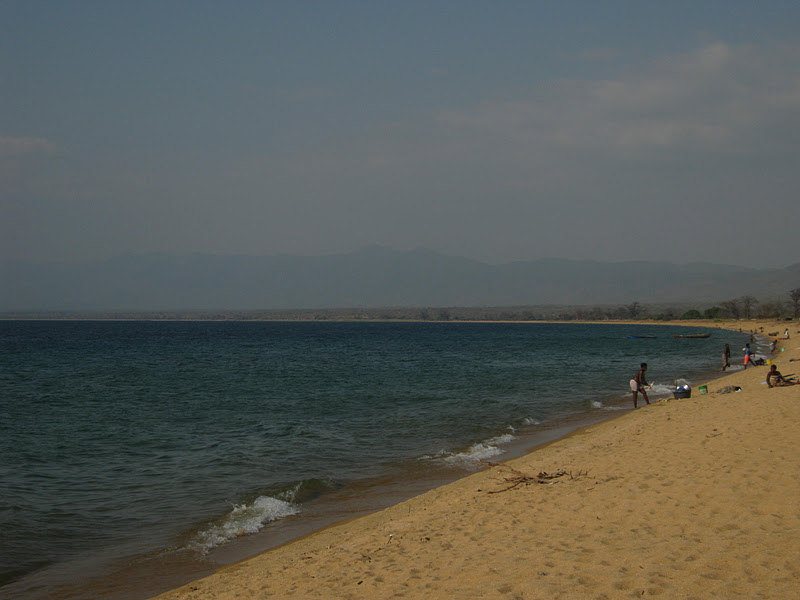
Metangula, Mozambique, on the shore of Lake Malawi. (KK)


[7 August]

I seem to have created a stir.                                                                                                                                                                                 
“Metangula?” I asked the man standing just inside the door to the big, battered bus.

“Metangula,” he reassured me.

“Metangula!” chorused several nearby passengers, all of them male, all of them grinning. Some made as if to move over and make room for me on their seats, but the bus man gestured that I should go to the very back, where the last free seats were. A young guy, joshing to his friends in Portuguese, left his seat and climbed back to keep me company.

I had just flown into Lichinga, Mozambique on a 737, hopped into a taxi and ridden straight to the dirt lot that serves both as a marketplace and as the boarding spot for chapas, the old buses and flatbed trucks that are northern Mozambique’s transportation system.  Just as I’d been told, in front of a shop called Handling waited a white-painted schoolbus destined for Metangula, the small lakeside town I was headed for. The plan was to spend the night in Metangula, then take another chapa further north along Lago Niassa (aka Lake Malawi) to Cóbuè and from there either take a boat or walk three hours to the Manda Wilderness. I knew the place I’d signed on to volunteer for a month was remote, but I was only beginning to understand how remote. 

The ­chapa guys had hustled me and my bags on board as if the bus would be taking off any second. But though the last seats filled within minutes and all the luggage was already piled behind the driver, we sat for another hour in the mercado. Domingo, the young man who seemed to think fortune had smiled upon him when I got on the bus, tried his best to chat me up.

“Where are you from?”

“The United States.”

“The United States!” He conveyed this information to his buddies further up. “Are you married?”

“No.”

“Why not?”

I shrugged. He seemed to have run out of English, and in any case he looked maybe 19 years old. So I just smiled at him and looked out the window at the mercado’s small shops, some painted concrete, others just ragged rush-and-stick structures. Litter stood in drifts, and clothes and shoes were laid out on the ground for sale. Women with cloth-wrapped bundles on their heads passed by, but vendors didn’t lay seige to the bus as they had in Madagascar. If you wanted something—some fruit, a roll—you called out the window and asked for it.

Finally the bus started, but only to go two blocks and pull into the long line at the gas station. With the aisle full of bags, the quickest way out was through the windows, and four or five guys jumped through to stretch their legs until it was our turn at the pump.

“How long will it take us to get to Metangula?” I asked Domingo.

“Hour and half,” he said, “mais ou menos.” This turned out to be wildly optimistic, and we had more stops to make even before we left Lichinga. Minutes after we left the gas station, we stopped again, this time at a bakery. Passengers poured out and came back with bags of bread and rolls.

Everyone on the bus seemed to know each other and they joked and laughed and talked in Portuguese and Chinyanja, undisturbed by all the delays. Some called out the window to friends or waved and grinned at people passing by. We stopped at a police checkpoint and an officer with a clipboard walked slowly all around the bus. He looked in the window, noted there was just one person per seat and waved us on our way.

Inspection duly passed, it was time to really load up. We stopped at a cluster of thatched-roof mud houses every twenty minutes or so, and at every stop, passengers climbed in and out through the windows, laughing and greeting their friends, squeezing onto one of the jump seats that folded down over the aisle or finding a place on someone’s lap.

One woman passed a dangling pair of chickens, tied together at the leg, out through the window before she got out herself. The guy in the seat ahead of me, a thin young man in a gray track suit, a stylish haircut and slick shades, reached through the window and gathered in a cloth-wrapped baby, holding and talking to it as its mother grabbed the window frame and clambered up the side of the bus.

The more people crammed in, the more everyone laughed, and the whole enterprise became a traveling party. As the bus stopped for yet another cluster of passengers waiting by the side of the road, the guy in the track suit called out to them, “Metangula! Metangula beach safari!”

A broad-faced young guy with a red shirt perched himself on the back of a seat in the middle of the bus and put his bare feet up on the back of the next seat forward. He took on the role of party director, talking loudly to the crowd and getting grins and chuckles in response. His perch gave him a good view of the people getting on and off, so he would yell to the driver--“Alfonso!”--whenever he considered it time to go.

I had a window seat in the last row, so I had a good vantage point both for the party on the bus and the hilly, dusty landscape passing by. At one stop, a man called out the window to a boy standing in front of a thatched house to bring him a cup of water, which he did, running with a worried expression and a tin cup filled almost to the brim. Party Guy yelled to Alfonso not to leave till the kid made it to the window.

At another stop, a man selling stalks of sugar cane came to the bus windows to take orders, a two-year-old kid on his hip. When he saw me in the window, he laughed outright and pointed me out to the baby. Two little girls standing nearby just stared at me, but when I waved to them they broke into grins and waved back, one of them with her hands in a pair of big red rubber kitchen gloves. At another stop, I saw kids riding scooters made completely of wood—axles, wheels, and all.

For long stretches, there was no sign of human habitation in sight, just brown grasses, a few trees and distant hills. Then we’d pass a cluster of square houses made from mud bricks plastered with more mud, with rush grass roofs held up by wooden poles. Some stood on their own, some were enclosed in compounds with reed walls all around.

Bandeze, Mozambique from the chapa. (KK)
As we got closer to the lake, the landscape got greener and the bus crept down the hills. Maybe four hours after we left Lichinga, the general stir on the bus made it clear we were approaching Metangula. More mud houses appeared along the road, and as the stops became more frequent, I realized I didn’t know exactly where to get off. It was late in the day by now and I asked Domingo whether he knew the two guesthouses whose names I’d gotten from Lonely Planet. He didn’t and to my dismay he yelled forward to Party Guy.

Just what I don’t want, I thought, the whole bus knowing I don’t know where I’m going. Party Guy did his best to help, but out of the stream of Portuguese he unleashed, the only word I recognized was “praia” (beach).

“Sim,” I said. I wasn’t sure exactly where these places were, but I thought they were on the beach.

The bus had stopped now at a crossroads beyond which the pavement turned to sand. Mud houses lined the streets and a long mud wall was brightly painted with ads for cell phone companies. More than half the people were off the bus, and though it looked distinctly unpromising, Party seemed to think I should get off here.

He climbed out the window and indicated I should do the same.  But my backpack was in the pile up near the driver, and the bus seemed empty enough now that I thought I could clamber forward over the sacks of corn and the jump seats and get it. And though it probably violated all chapa-riding etiquette, that’s what I did, saying, “Desculpe, desculpe” all the way.

Then there I was in a tiny, mud-house town with the light fading and no idea where I’d spend the night. I missed Rie. I wished I’d learned more Portuguese.

But Party wasn’t about to leave me stranded. He offered by gesture to take my shoulder bag and show me to a place I could stay. And however rowdy he’d been on the bus, his face now showed nothing but polite concern. So I gave him the bag and went with him around the corner and down the dirt street toward the broad blue lake, above which the red ball of the sun hung half in cloud. Humped cattle and a black goat crossed in front of us, followed by a young boy driving them home, and on the shoreline I could make out a line of people washing pots and pans and themselves in the lake.

Party took me to the only accommodation in sight, the Casa de Hospedes Bela Vista, a row of small, stark, hot concrete rooms with a smelly bathroom at one end. But it was cheap and there didn’t seem to be any choice. 

I took this picture the next morning, not that I'll ever quite forget this place! (KK)
I told the hotel guy I’d take it and then asked if there was a public phone in town—I wanted to call the people at Manda Wilderness and let them know I’d made it this far. He pulled his cell phone out of his pocket and offered it to me, but it was a long distance call and I didn’t want to wipe out his minutes. “Existe Internet aqui?” I asked.

He didn’t understand. I pulled out my little Portuguese dictionary, but the word was the same—internet. I pointed to it, but he looked just as befuddled as before. Party and another guy huddled around the dictionary. Party too looked confused but the other guy knew what it meant. But no, he said, no internet in Metangula.

Food was more easily found. Party indicated I could clean up if I wanted and he’d walk me to a place I could eat and then later I could come back here and sleep. I braved the smelly toilet—where it turned out there was no running water, just a big pan of water with a dipper in it—and went with him back around the corner and up the dirt street to a big screened place with red plaid tablecloths and green plastic chairs and a half-dozen people who looked at me very curiously.

I offered to buy Party a beer to say thank you, but he looked very uncomfortable at the idea. Finally he nodded at the order window and asked, “A Fanta?”

“Sim,” I said. “Please get yourself a Fanta.” He came back with a Coke and sat at the table next to mine, downed the soda in record time, shook my hand and left.

I ate a good meal of fish and rice and asked the woman who ran the restaurant when the chapa heading north would leave the next morning. When I tried to leave a tip, she gave the money back to me with a smile. “No,” she said kindly. “Keep it for the chapa.”

I slept better than I expected in my prison-cell room and woke at daylight to find the village already in motion—cattle and goats in the street, women heading back from the lake with big plastic pails of water on their heads, a small cluster of people on the corner waiting for the chapa.

Metangula (KK)

Soon I’d join them. In fact, I would spend six hours on that street corner before the flat-bed truck was ready to carry us north, and then another four hours—including radiator breakdown and repair—getting to Cóbuè and the boat. 

Loading up for Cóbuè. (KK)

The battered windshield, the battered road. (KK)


Coming into Cóbuè.


But a night in Metangula had reminded me that my fellow humans can be tremendously kind. And even in the remotest corners of the world, you can suddenly feel you’re among friends.  

“Excuse me!” I heard as I headed for the chapa corner. “Excuse me!”

It was Party, heading for the lake with a buddy by his side. He shook my hand with great enthusiasm and apparent pride that this stray white person he’d taken under his care was still alive and kicking the next day.

(KK)